How Gangs Recruit Youth: Signs, Strategies, and Solutions

Street gangs have been a persistent problem in communities across the United States, and Ventura County is no exception. As I detail in my book Less Tagging More Killing, the transformation of gangs from neighborhood groups of taggers into sophisticated, violent organizations has left deep scars on families and cities. One of the most troubling realities I witnessed during my years as an FBI Special Agent was the relentless way gangs bring young people into their ranks. To confront the problem effectively, communities must understand How Gangs Recruit Youth: Signs, Strategies, and Solutions.
The Appeal of Belonging

The first step in understanding How Gangs Recruit Youth: Signs, Strategies, and Solutions is acknowledging the powerful sense of belonging gangs offer. Many teenagers, especially those without a father present, crave a sense of being wanted. A young person who feels invisible at school or unwanted at home is easy prey for gang recruitment.
In neighborhoods like Oxnard’s Colonia or Santa Paula’s east side, kids see gangs not as outsiders but as part of the local culture. Graffiti, hand signs, tattoos, and clothing send subtle messages to youth: This is who we are. This is how you belong. For a 13-year-old trying to be acknowledged, the gang becomes a family that appears more stable than their own. To learn more read the blog Why Do People Join Gangs? Causes and Consequences.
Recruitment Strategies

During my investigations, I observed recurring tactics gangs use to pull youth into their destructive world. These strategies are both subtle and overt, and they evolve with the times:
- Exposure Through Family and Friends
In many cases, kids don’t need to be recruited—they’re born into the gang environment. Older brothers, cousins, or even parents normalize criminal behavior. A boy who grows up watching his brother flash gang signs or his uncle brag about past arrests often sees the gang lifestyle as inevitable. To learn more read Hispanic Gangs: Inside The Dirty Nickel. - Street-Level Enticement
Hanging out at parks, schools, and community centers, gang members identify vulnerable teens. They offer protection, alcohol, drugs, or even just attention. Before long, the teenager feels indebted to the group. Many gang members I interviewed described themselves as impulsive or “up for anything”. - Digital Recruitment
Social media has become a new hunting ground. Gangs post pictures with firearms, stacks of cash, and parties to glamorize the lifestyle.
To learn more read the blog Gang Initiation Fight: Understanding the Brutal Gateway to Gang Life.
Warning Signs Parents Should Watch

Recognizing the early signs of recruitment is critical. Often parents and teachers miss the red flags until it’s too late. If we want to tackle How Gangs Recruit Youth: Signs, Strategies, and Solutions, awareness must start at home. Look for:
- Sudden changes in clothing, especially adopting one sports team or brand linked to local gangs.
- Use of graffiti-style writing in notebooks, on shoes, or bedroom walls.
- New “friends” who have bad reputations in the neighborhood.
- Increased defiance at school, slipping grades, and skipping classes.
- Tattoos or drawings with numbers, initials, or symbols tied to gangs.
- Possession of unexplained money, drugs, or alcohol.
One of the biggest indicators I saw repeatedly in Ventura County was graffiti practice. Teens would spend hours sketching “placas” or tags. The prospective gang member would send the images via instant messages to others for approval. It was step one on the road to gang membership.
What Crimes Do Gang Members Commit First?
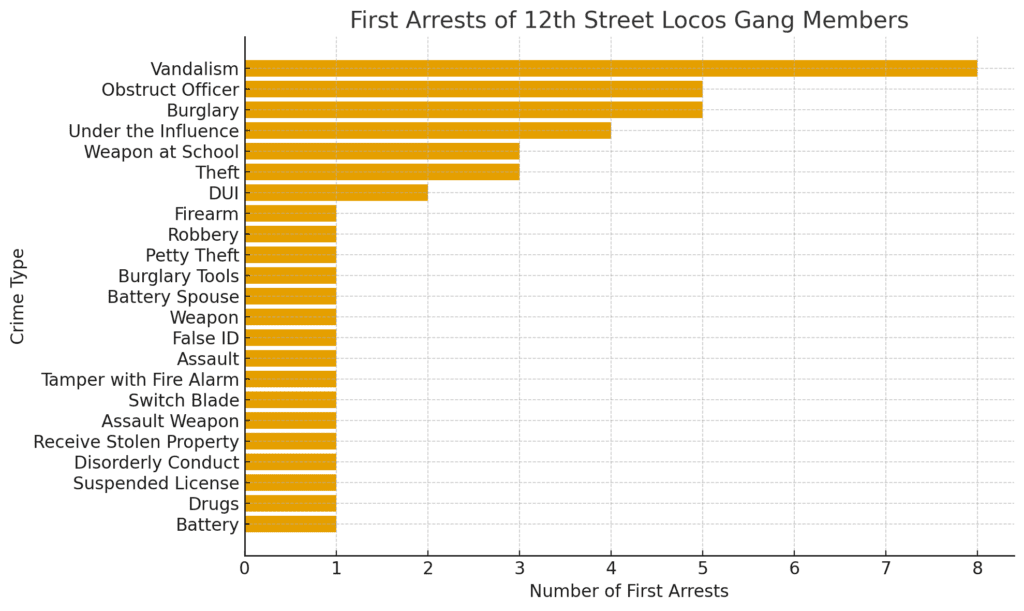
When I examined the criminal histories of 46 documented members of the Santa Paula gang the 12th Street Locos, I wanted to see what their first arrests looked like. The results revealed that there is no single path into the criminal justice system, but patterns do emerge. Approximately 40% of the gang members were arrested for the first time for vandalism, burglary, or obstructing an officer.
- Vandalism was the most common starting point, with 8 members (17%) first arrested for tagging or graffiti.
- Obstructing an officer and burglary each accounted for 5 (11%) first arrests.
- Substance issues surfaced early as well: 4 arrests for being under the influence, and 2 for DUI.
- Weapons violations were present from the start, including 3 arrests for weapons at school.
- The rest of the first arrests were scattered across crimes like theft, robbery, battery, false ID, disorderly conduct, and drug possession.
What this data shows is that while many gang members begin with lower-level offenses like vandalism, and burglary, others escalate immediately into more serious crimes involving weapons, violence, or drugs. In other words, there’s no single gateway crime—but early involvement in illegal activity is a strong predictor of deeper gang entrenchment. To learn more read the blog Gang Related Crime Statistics: Trends and Analysis.
The Costs of Recruitment
Recruitment isn’t just about one teenager joining a gang; it’s about multiplying violence in an entire community. A single teenager drawn into gang life may rack up dozens of arrests over a decade. In Santa Paula, for example, small cliques of 40–50 members have been arrested thousands of times collectively. The cost to taxpayers in supervision, probation, parole, and incarceration runs into the millions annually.

Beyond money, the human cost is staggering. Recruited youth often become perpetrators and victims of violence before they reach adulthood. Drive-by shootings, assaults, and robberies frequently involve teenagers who were recruited just a few months earlier. To learn more read the blog Gangs and Violence: A Hidden Epidemic.
Community Solutions
To address How Gangs Recruit Youth: Signs, Strategies, and Solutions, communities must take a layered approach that combines prevention, intervention, and enforcement.
- Parental Involvement: The strongest barrier to gang recruitment is built at home, no matter the economic situation a loving two parent home protects youth against gang recruitment. Workshops that explain graffiti, tattoos, and local gang slang help parents recognize trouble early. However, the primary reason children join gangs is due to neglectful parenting.
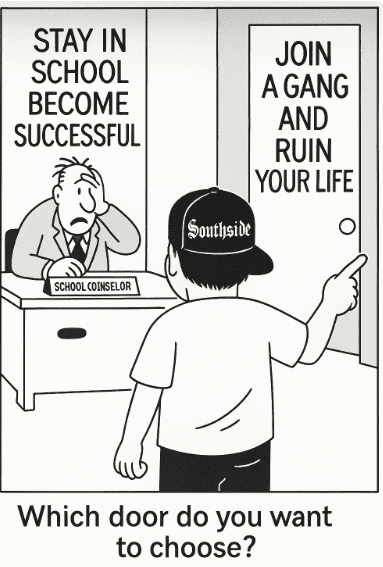
- Prevention Through Early Engagement: After-school sports, mentorships, and tutoring provide alternatives to idle time. In my experience, the kids most at risk were those left unsupervised after school hours. Unfortunately teachers are unlikely to dissuade a child from joining a gang. Most gang members I interviewed dropped out of junior high and high school.
- Law: It is illegal to use threats, force, or intimidation to coerce someone into joining a criminal street gang. I have never interviewed a gang member who did not voluntarily join a gang. Currently, there is no deterrent law to join a gang, but there should be.
Why This Fight Matters
Some people dismiss gangs as a permanent fixture in modern society, but communities do not have to tolerate gangs.
The question of How Gangs Recruit Youth: Signs, Strategies, and Solutions isn’t just academic—it’s a life-or-death matter for countless teenagers. Every child steered away from gang life means fewer shootings, fewer victims, and fewer grieving parents. To learn more read the blog What to Do About Gangs: A Street-Level Perspective.
Final Thoughts
In Less Tagging More Killing, I describe the evolution of gangs from graffiti crews into violent enterprises. But the story doesn’t end there. Gangs thrive only when they successfully bring in the next generation. Cut off the pipeline of youth, and the gangs wither.
By recognizing the signs, holding parents accountable, and aggressively applying legal solutions, we can protect vulnerable youth and restore safety to our communities.
Recruitment is not inevitable. It can be stopped. But only if we take seriously the lessons of How Gangs Recruit Youth: Signs, Strategies, and Solutions.
To learn more about gang recruitment get the book Less Tagging More Killing: